
This article was first published in 2013 as part of a larger academic report on market segmentation. Some data and references may be out of date but remain unedited. All figures are in USD unless stated.
Visit your nearest newsstand and you’ll find dozens of magazines all vying for your attention and money. With the magazine publication sector as crowded as ever, one would think publishers would move to differentiate their titles from their competitors. Yet as you stand in front of the newsstand, you may notice something: all these magazines kind of look the same!
Cover pages: same difference
When it comes to design and creative originality, independent magazine publishers appear to be leading the way, ahead of their mainstream counterparts. There are some exceptions like Bloomberg BusinessWeek, Wired Magazine and The New Yorker who often have some of the most creative covers out there. However, on the whole, there is a general sense of “creative inertia”, one reminiscent of the movie industry’s approach to movie poster designs. It appears that once a template for success has been established, studios (publishers in our case) tend to become less inclined to try new things. Perhaps there is a method to this madness. Decisions on cover designs would appear to have been made under the consideration of extensive research on the readers’ preferences and interactions. Essentially, we are continually shown what we like to see.

This lack of creative originality is prevalent most in the fashion and lifestyle “glossy mag” category. Titles which target a defined group all share similar traits in brand styling and presentation. This approach appears to be in contradiction to one of the underlying principles of branding: to stand out from competitors. The differences between these established magazines are very slight and their logos can easily be interchangeable.
To illustrate this point, I analysed the covers of the flagship fashion and lifestyle magazines of two of the biggest magazine publishers in the world, Hearst and Conde Nast. Given that these 2 are direct competitors, it was interesting to see so many similarities between competing products.
Serif fonts = high price
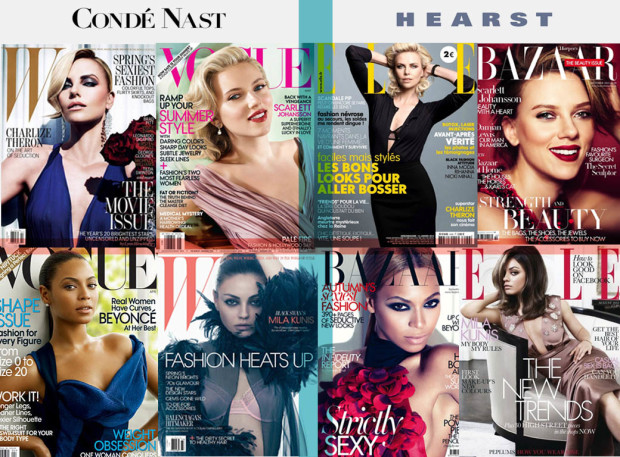
The following women’s magazines are positioned similarly on the market as high-end fashion editorials, and their prices reflect that; so does the branding and appearance. High subscription prices are seemingly not an issue for the target market. The median household incomes (HHI) of the target market are as such: W – $158,940, Vogue – $69,447, Harper’s Bazaar – $70,208, Elle – $79,898.
Pink, sex and all the single ladies
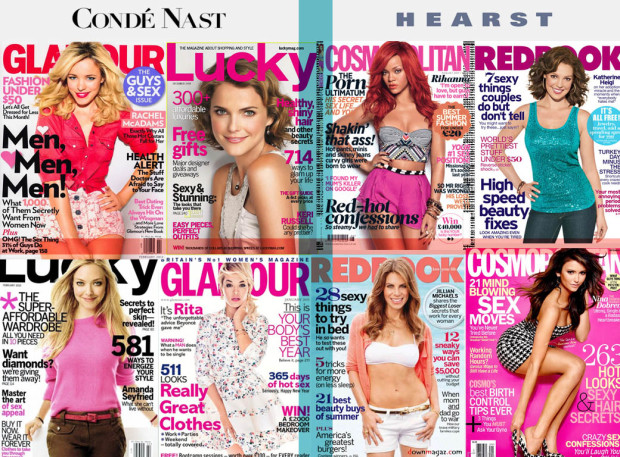
These general interest magazines are marketed as affordable and aspirational. The cover usually features a well-known female personality surrounded by messages intended to promote self-improvement. The word ‘Sex’ is used repeatedly throughout the magazines, and the highly feminised design scheme (a lot of pink and purple) also supports circulation statistics, which show reduced male readership compared to the higher-end female magazines. The median HHIs of Glamour and Cosmo readers are $66,992 and $61,150, respectively.
Men in suits or half-naked women
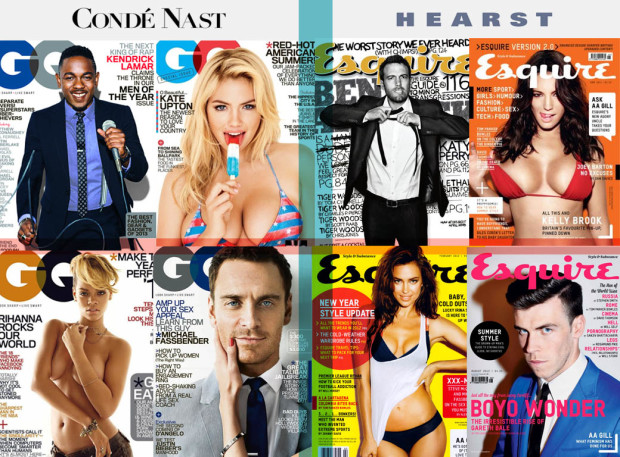
The male lifestyle magazine market is comparatively small, so the number of men’s magazines on offer is limited. The two most popular choices are GQ and Esquire. They are both positioned similarly on the market, share identical brand values and target the same market (Median HHI: GQ – $72,374, Esquire – $75,766). Like their female counterparts, the theme of the men’s lifestyle mags is similarly aspirational. Their quest can be simplified as ‘be the most stylish man with the sexiest woman. This might be a crude generalisation about men who earn above $70000, but a combined circulation of over 1.5 million per issue may suggest otherwise.
Market Segmentation: the end justifies the means
Magazine readers are one of the most widely segmented markets within media consumers. Through segmentation, publishers can break down broad markets into infinite clusters with a combination of geographic, demographic and psychographic variables. High-level clustering like this can enable independent publishers with niche titles to build a cult loyal readership base. By partitioning the market, publishers can study and understand their target market more deeply, which enables them to focus their publications on specific consumer groups.
The cluster diagram below shows a simple example of how publishers (or any marketer) can break down markets to identify commercially viable sectors. The diagram shows two regions within a target population. Each region is further differentiated by gender and income.

After clustering, it is obvious that for a publisher specialising in high-end female fashion magazines, targeting the eastern region provides the best chance of commercial success, even though there is an overall larger female population in the western region. This is simply because there are more female high earners in the East. Likewise, a competitively priced men’s general interest periodical would do well to target the male-dominated western region.
Summary
It is clear that segmentation allow magazine publishers to position their product across a wide market. However, the most successful magazines brands tend to take a similar positioning stance for every market segment. Yet the fact that these magazines remain relatively successful suggests they may be doing something more beyond the cover page.
